
How to Answer 11+ NVR Reflection & Rotation Questions
A reflection or rotation question shows you one figure and gives you an instruction: reflect it in a mirror line, or turn it by a quarter, half or three-quarter turn. Your job: pick the option showing the figure after the move.
This type feels alien at first because it asks you to move a picture in your head — something school rarely practises. But it is the most learnable NVR type of all, because there are only a handful of moves, and each one has a fixed effect you can memorise: a vertical mirror swaps left and right; a horizontal mirror swaps top and bottom; a quarter turn sends the top to the side. The figures themselves barely matter — an arrow, a triangle, a dot in a corner — because the checklist features that move are always the same: shape, size, shading, number, position, direction. In this type, shape, size and shading usually stay put; only position and direction dance.
Master the handful of moves and every question becomes the same thirty-second routine.
The method
- A mirror swaps left and right — the top stays the top. Imagine folding the page along the mirror line. (A horizontal mirror does the reverse: top and bottom swap, left stays left.)
- Pick one small detail, like an arrow tip, and work out where the mirror sends it. Check the answers against just that detail first — one tracked point kills most wrong options.
- Decide: flipped like a mirror, or spun like a wheel? A reflection swaps left and right; a rotation moves everything around. Name the move before you look at a single option.
- For turns, use the clock. A quarter turn clockwise sends "pointing up" to "pointing right"; a half turn sends everything to the opposite side.
- For double instructions, do one move at a time. Mirror first, then turn — write the in-between figure in your head before applying the second move.
A worked example
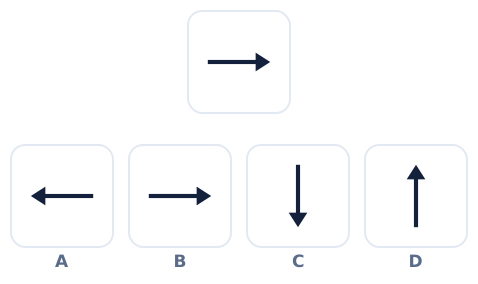
Reflect the figure in a vertical mirror line. Which is correct?
- The figure is an arrow pointing right. The instruction is a vertical mirror — so left and right swap, top stays the top.
- Track one detail: the arrow's tip points right, so the mirror sends it to point left.
- Check the options against that single detail. A points left — correct. B still points right: that's the unchanged figure. C points down and D points up — those are quarter turns, not reflections.
- One option matches the move.
Answer: A
The rules you'll meet
Only a handful of moves appear, alone or in pairs:
- The vertical mirror — left and right swap: a right arrow becomes a left arrow; a top-right dot moves to top-left. Top stays top.
- The horizontal mirror — top and bottom swap: a down arrow becomes an up arrow; a bottom-right dot moves to top-right. Left stays left.
- The quarter turn (90°) — clockwise or anticlockwise. An up arrow turned clockwise points right; a top-edge dot turned anticlockwise moves to the left edge.
- The half turn (180°) — everything moves to the opposite side: a bottom-right dot lands at top-left; an up arrow points down.
- Doubled moves — two quarter turns make a half turn; a mirror followed by a turn, or two mirrors in a row. Do them one at a time, in order.
- Track-the-marker questions — the figure is a shape with a dot on one corner or edge, and the whole question is: where does the move send the dot?
The traps
Mirror versus rotation. The classic. A right arrow reflected points left — but so does a right arrow given a half turn. On some figures the results differ, and the options include both. Always apply the move that was asked, not the one that gives a familiar picture.
The wrong mirror. Vertical mirror, horizontal flip — easy to swap under time pressure. Say it as an action first: "vertical line, so left-right swap."
The unchanged figure. The original is nearly always among the options. Mirrors and turns almost always change a figure that isn't symmetric — if your answer looks identical to the start, check your move.
Second-move slip. In doubled instructions, applying both moves to the original instead of chaining them. The second move acts on the result of the first — build the in-between picture.
Related
- The complete 11+ question-type guide
- NVR: Analogies — turns and flips hidden inside A-to-B changes
- NVR: Series & Sequences — rotation as a repeating step
All example questions come from the Brainblox question bank — practise this question type inside 15 arcade games, timed mock exams and focused practice. Brainblox is an independent app: not affiliated with, endorsed by or licensed by any exam board, school or assessment publisher, and it contains no past papers.