
How to Answer Every 11+ Question Type: The Complete VR & NVR Guide
Most 11+ exams include English and Maths papers too. This guide covers the two reasoning papers. Verbal Reasoning (VR) is made of puzzles built from words, letters and numbers. Non-Verbal Reasoning (NVR) is made of puzzles built from shapes and patterns. Most children never meet either kind at school.
The good news: every question in the reasoning papers belongs to a small family of question types, and every type has a method. Once you know the method, a question that looked impossible becomes a routine you've done fifty times.
This guide covers every VR and NVR type, one at a time. For each one you get a real example question, the step-by-step method, and, for most types, the trap people fall into.
The four golden rules (they work on every question)
1. Read the question twice before you look at the answers. Know exactly what you're hunting for. A lot of wrong answers are really right answers to a slightly different question.
2. Cross out the impossible answers first. You'll usually be left with just two to think hard about. Elimination is faster than working forwards, and it works even when you're stuck.
3. Try each answer like a key in a lock. If you can't work forwards from the question, work backwards from the options — one of them will click.
4. In the exam, never leave a blank. There are no marks taken away for wrong answers, so an educated guess after crossing out two options is always better than an empty box.
Some papers give you answer options to choose from. Others ask you to write the answer yourself. Rules 2 and 3 only work when options are printed — on a write-in paper, lean harder on rule 1 and on the method for that type.
Part 1: Word meaning
Closest Meaning (synonyms)
What it looks like:
Choose the word most similar in meaning to: FRAGILE A. delicate B. sturdy C. dusty D. spare
The method — SWAPS:
- Spot the word closest. Closest, not opposite.
- Word one: what does it mean? Fragile means easily broken.
- Against all three, in order. Check fragile against each option in turn.
- Put both in one sentence. "A fragile glass." "A delicate glass."
- Same meaning? Prove it. Yes, so the answer is delicate.
The trap: sturdy, the opposite, planted to catch a rushing eye. Step 1 is what saves you.
Closest Meaning pairs (one word from each group)
What it looks like:
Choose one word from each group that are closest in meaning. (jolly, grumpy, brave) (merry, tired, gentle)
The method — SWAPS:
- Spot the word closest. Closest, not opposite.
- Word one: what does it mean? Jolly means cheerful.
- Against all three, in order. Jolly and merry? Both mean cheerful.
- Put both in one sentence. "A jolly crowd." "A merry crowd."
- Same meaning? Prove it. Yes, so the answer is jolly and merry.
The trap: teammates, not twins. Grumpy and tired feel as if they belong together, but you can't swap one for the other.
Opposite Meaning (antonyms)
An Opposite Meaning question gives you two groups of three words. You want the two, one from each group, that are most opposite. Watch for a pair across the groups that means the same: it is planted to catch a rushing eye.
The method — POLES: Pick one from each group · One word against all three · Look for the exact reverse · Either way round · Select both words. It is worked through just below.
The trap: a pair inside one group never counts, however opposite it is.
Opposite Meaning pairs (one word from each group)
What it looks like:
Choose one word from each group that are most opposite in meaning. (sticky, sweet, gloomy) (juicy, bitter, tender)
The method — POLES:
- Pick one from each group. Never two from the same group.
- One word against all three. Sticky, then sweet, then gloomy, each against all three. Nine pairs.
- Look for the exact reverse. Sweet and bitter.
- Either way round. The opposite of sweet is bitter, and the opposite of bitter is sweet.
- Select both words. The answer is sweet and bitter.
The trap: a pair that means the same, or just goes together, is not an opposite. Sticky and juicy feel like a pair, but neither reverses the other.
Odd one out (words)
What it looks like:
Three of these five words go together. Which TWO do not belong? A. gleam B. glisten C. sparkle D. crumble E. wobble
The method — SHARE:
- Scan all five. Read every word first. All five are doing words, so that link picks out nothing.
- Hunt for three that mean the same. Not just the same topic: three you could swap in a sentence. Gleam, glisten and sparkle.
- Add a label. They all mean shine.
- Rule out the other two. Crumble and wobble don't mean shine, so the label is right.
- Exactly two left. The answer is both of them, D and E: crumble and wobble. Two words, never one.
The trap: a spelling pattern is not a group. Sparkle, crumble and wobble end the same way, but they don't mean the same thing. Go by meaning, never by letters.
Related Words
What it looks like (an easier practice version, with only one word missing):
Wasp is to swarm as fish is to ? A. shoal B. river C. scale D. fin
The method — LINKED: Link it in a sentence · In the second group, test it · No partner? Next word · Kind of word must match · Exact link wins · Decide on both words. The full version is worked through in the next section.
Here the steps run short. "A swarm is a group of wasps", so "a shoal is a group of fish". "A fish lives in a river" is true too, but the exact link wins: shoal.
The trap: right topic, wrong link. Fin and scale are about fish, but neither is a group of fish.
Related Words (one from each bracket)
What it looks like:
Choose one word from each bracket so that the two pairs go together in the same way. Write is to (wrote, writer, writes) as ride is to (ridden, riding, rode)
The method — LINKED:
- Link it in a sentence. "Wrote is the past of write."
- In the second group, test it. Ridden and rode both fit.
- No partner? Next word. Wrote has a partner, so stay.
- Kind of word must match. Both are doing words.
- Exact link wins. "I rode", not "I ridden".
- Decide on both words. Answer: wrote and rode.
The trap: writer. A writer writes, but there is no rider in the second group.
Double meanings
What it looks like:
Only one of the five answers goes equally well with both pairs of words. (field, ground) (throw, hurl) A. toss B. bowl C. meadow D. lawn E. pitch
The method — TWICE:
- Take in both brackets first. The options can wait.
- Word for each bracket. Land, and throwing.
- In one bracket? It's out. Toss and bowl are throwing only. Meadow and lawn are land only. Pitch reaches both.
- Check both meanings. A pitch is a playing field, and to pitch is to throw.
- Each bracket, one sentence. "We ran onto the pitch." "Pitch the ball." The answer is pitch.
The trap: the perfect fit for one bracket. Meadow is a great word for a field, which is exactly why it is there.
Compound words
What it looks like:
Choose one word from each group that together make a real word. (bus, car, van) (cub, hen, pet)
The method — JOIN:
- Join, group one first. Bus, car or van goes in front. That makes nine joins.
- One starter at a time. Buscub, bushen, buspet: no. Then car.
- Is it a real word? Carcub, carhen: no. Carpet: yes.
- Nail the letters. C-A-R and P-E-T, nothing added or dropped. The answer is car and pet.
The trap: looking for meaning. A carpet is neither a car nor a pet. And the sound can change when the parts join, so judge each join by its letters.
Part 2: Letters and word-building
Hidden Word
What it looks like:
Find the pair of words that contains a hidden four-letter word. "The old bus carried tourists uphill." A. The old B. old bus C. bus carried D. carried tourists E. tourists uphill
The method — SPLIT:
- Skip the meaning. Buses and tourists are not the point. Look at the letters.
- Pair by pair. Start with "The old", one gap at a time.
- Look at all three splits. Four letters can sit across a gap only three ways: three and one, two and two, one and three. Try all three at every gap.
- Is it a real word? "The old" and "old bus" make nothing. At "bus carried", one and three gives s + car = scar.
- Take the pair. The answer is C, bus carried: the pair, not the hidden word.
The traps: a word inside one word doesn't count. Tourists holds tour and uphill holds hill, but neither crosses a gap. And look, don't listen: a hidden word often sounds nothing like the words it sits in.
Move a letter
What it looks like:
Take one letter out of the first word and add it to the second word, so that both are still real words. GRASP → FEE A. g B. r C. a D. s E. p
The method — SPARE:
- Scan word 1. Without the g: rasp ✓. Without the r: gasp ✓. The rest leave nothing.
- Pick the survivors. Two survive, g and r, so keep going.
- Add it to word 2. At the front: gfee ✗, rfee ✗.
- Run it along the gaps. The r, one gap in, makes free ✓.
- End on both real. Gasp and free: the answer is r.
The trap: stopping too soon. The letter is often not the first one, and often goes inside word 2: check every letter and every gap.
Complete the Word
What it looks like:
Three letters have been taken out of the word in capitals. Find them. "A heavy SER soaked the garden." A. HOW B. PIG C. MAT D. CUP E. JAM
The method — SPELL:
- Scan the sentence. Something heavy that soaks a garden: a thing.
- Picture the word. Shower: S, three missing letters, then E and R.
- Each option, every gap. Try each one in every gap. Only HOW makes a word: S + HOW + ER.
- Letter by letter. S-H-O-W-E-R matches shower.
- Look back at the sentence. "A heavy shower soaked the garden." It makes sense, so the answer is HOW.
The trap: the gap can be anywhere, even in front of the first capital, and some options build the word with one letter wrong. Check every gap and every letter.
Letter Connections
What it looks like:
The same letter finishes the first word and starts the second, in both pairs. as [?] it des [?] ey A. k B. t C. d D. n E. s
The method — FOUR:
- Finish one word, start the next. One letter, four words.
- One place first: in front of a bracket. Try all five letters on the end of des. Only k makes a word: desk.
- Use each survivor in all four places. Ask, kit, desk, key.
- Read all four words. Four real words, so the answer is k.
The trap: three out of four is still wrong. A letter can make the whole first pair and still fail the second.
Word pairs (spot the letter trick)
What it looks like:
Find the word that completes the last pair in the same way as the first two pairs. (jacket, cake) (market, rake) (family, [?]) A. fail B. film C. mail D. mild E. lily
The method — SLOTS:
- Spot the doubles. No letter appears twice in jacket. (A doubled letter has two slots: pair two decides.)
- Label the letters. In your head: j1, a2, c3, k4, e5, t6.
- Order the slots. Cake is slots 3, 2, 4, 5, in that order.
- Test it on pair two. Slots 3, 2, 4, 5 of market spell rake ✓.
- Spell it, then search. Family gives m, a, i, l: mail.
The trap: look-alike words. Fail is one letter off mail, so check every letter is in its place.
Make a Word
What it looks like:
Find the missing word in the second group, which follows the same pattern as the first. (clam [let] extra) (twig [?] owner) A. ton B. win C. won D. row E. wig
The method — STEAL:
- Stack the groups. Picture twig under clam, and owner under extra.
- Trace each letter to its word and place. L: 2nd of clam. E and t: 1st and 3rd of extra.
- Explain the recipe in places. 2nd of the first word, then 1st and 3rd of the last. It rebuilds let.
- Apply it to group two. W from twig, then o and n from owner.
- Look for your word, letter by letter. Won. Ton and win are one letter off.
The trap: letters can come from any place, in any order, and most options can be made from group two's letters. Only the recipe decides.
Part 3: Codes
Letter codes
What it looks like:
If the code for CAT is DBU (each letter moves on one), what is the code for DOG? A. EPH B. CPF C. EOH D. EPG
The method:
- Line the word and its code up letter by letter: C→D, A→B, T→U.
- Count the jump for each letter along the alphabet. Here every letter moves forward one.
- Apply the same jump to the new word: D→E, O→P, G→H.
- Answer: EPH.
Many papers print the alphabet at the top of the page for letter questions — look for it first. If it isn't there, write ABCDEFGHIJKLMNOPQRSTUVWXYZ in the margin of your booklet as soon as you reach the first letter question. Most letter puzzles are secretly counting puzzles.
The trap: assuming the jump is the same for every letter without checking. Some harder codes move the first letter +1, the second +2, and so on. Check two letters before you trust the rule.
Alphabet code (A=1, B=2 …)
What it looks like:
Using A=1, B=2, C=3 … which word do the numbers 3, 1, 20 spell? A. DOG B. CAT C. BAT D. COT
The method:
- Turn each number back into its letter: 3=C, 1=A, 20=T.
- Read the word: CAT.
Worth memorising before exam day: A=1, E=5, J=10, O=15, T=20, Z=26. With those six anchor points you can find any letter quickly by counting a step or two, instead of counting all the way from A.
The trap: splitting a two-digit number. In this code 12 means L, not "1 then 2" (which would be A then B). Read the numbers as they are written.
Number codes (the hard one)
What it looks like:
Three of these four words are given in code. The codes are not written in the same order as the words, and one code is missing.
COAT TORN BORN CORN 6547 3512 2547
Find the code for CORN.
The method:
- Look for what repeats. Three of the words end in -ORN, so their codes must share the same last three digits. Codes 6547 and 2547 both end in 547 — so O=5, R=4, N=7.
- Identify the leftover. 3512 doesn't end in 547, so it must be COAT → C=3, O=5, A=1, T=2. (Check: the O=5 matches. Good.)
- Use the new letters. TORN starts with T, and T=2 — so 2547 is TORN, which means 6547 is BORN.
- Build the answer from the letters you've cracked: C(3) O(5) R(4) N(7) = 3547.
The trap: matching the first code to the first word. The question tells you the codes are shuffled — the whole puzzle is working out which code belongs to which word. Repeated letters (and repeated word-endings) are the way in.
Part 4: Maths in disguise
Letter and number series
What they look like:
What comes next? 6, 13, 20, 27, ? A. 33 B. 34 C. 36 D. 35
What comes next? BG, CJ, DM, EP, ? A. ET B. FS C. GS D. FR E. FT
Number series — JUMPS: Judge the row · Untangle the two series · Measure the jumps · Push on one jump · Step back to check. This short row is one series. Every jump is +7, so one more from 27 makes 34, and 34 − 7 = 27 checks back. A long row that goes down, up, down, up is two series woven together: keep only the gap's.
Letter series — LEAPS: Line up two rows · Every hop, counted on the alphabet · Ask: does the hop change? · Push each row on one hop · See both letters match. They come as pairs, with the alphabet printed above. The first letters, B, C, D, E, go one on; the second letters, G, J, M, P, go three on. One more hop each makes FS.
Letter analogies — SHARP: Split it · Hop-count each one · Ask if it makes sense · Run it on the third pair · Prove both letters. Sometimes it is an analogy instead: "DF is to GH as MO is to ?" Nothing is continuing here. D to G is three on, but F to H is only two on, so MO becomes PQ. The two letters usually move by different amounts: count each on its own.
The traps: count the letters you land on, not the one you start from. From D, E is one, F is two and G is three. And half right is still wrong, so check both letters.
Letters for Numbers
What it looks like:
If A = 6, B = 13, C = 4, D = 37, E = 58, what is the answer to this sum, written as a letter? A × C + B = [?]
The method — SUMS:
- Swap each letter for its number. 6 × 4 + 13.
- Use the right order. Times first: 6 × 4 = 24. Then add: 24 + 13 = 37.
- Match the total to a letter. 37 is D's number, so the answer is D.
- Sum it again. 24, then 37. Still D.
The trap: the answer is the letter whose number it is, not the letter at that place in the alphabet. The numbers change every question, so never assume A is 1.
Complete the Sum
What it looks like:
Find the number that balances both sides. 24 ÷ 4 = 5 × 4 − [?] A. 14 B. 6 C. 20 D. 12 E. 16
The method — SCALE:
- Solve the free side. The side with no gap: 24 ÷ 4 = 6.
- Call it the target. The gap's side must make 6 too.
- Answer the part without the gap. 5 × 4 = 20.
- Level the scales. 20 must come down to 6, so the gap takes off 14.
- End by weighing both sides. 20 − 14 = 6 ✓. The answer is 14.
The trap: a number from the way there (6 or 20), or a near miss (12 or 16). Weighing both sides catches them.
Part 5: Reading Information
GL groups two closely-related question types under Reading Information. Some give you a set of facts and ask you to work out the one answer they lead to; others give you facts and five statements and ask which one must be true. It's the same skill — read carefully, use only what's written, follow the links — in two flavours.
Reading Information: work out the answer
What it looks like:
Emma has 12 pencils. Jack has 5 fewer pencils than Mia. Mia has 3 more pencils than Emma. How many pencils does Jack have? A. 8 B. 10 C. 12 D. 7 E. 15
The method:
- Deal with one clue at a time, completely, before moving on — and start from the person you actually know: Emma has 12.
- Chain outwards: Mia has 3 more than Emma → 12 + 3 = 15.
- Jack has 5 fewer than Mia → 15 − 5 = 10.
- Notice the clues came in the "wrong" order — the Jack clue is first but must be solved last. Reorder them so each step uses a number you already have.
The trap: trying to hold all three clues in your head at once. Write the numbers down as you find them: Emma 12, Mia 15, Jack 10.
Reading Information: what MUST be true?
What it looks like:
A bus service runs between Market Street and the Station. Buses depart Market Street at 10, 25 and 50 minutes past each hour. The first bus leaves at 7.10 am and the last bus leaves at 10.50 pm. The journey takes 15 minutes. On Sundays, the service does not run before 9 am.
All of the information above is true. Exactly one sentence below must be true as well — which one? A. Buses run every 15 minutes throughout the service. B. A bus arrives at the Station at 7.15 am on weekdays. C. A bus leaves Market Street at 7.30 am on Mondays. D. On Sundays, the first bus leaves Market Street at 9.10 am. E. The last bus arrives at the Station at 11.10 pm.
The method:
- This type is elimination all the way: test each option against the facts and knock out anything that fails.
- A: the gaps between :10, :25 and :50 are 15, 25 and 20 minutes — not always 15. ✗
- B: the first bus leaves 7.10 and takes 15 minutes, arriving 7.25 — not 7.15. ✗
- C: there is no :30 departure slot at all. ✗
- D: on Sundays nothing runs before 9 am, so the first valid slot is 9.10 am. This must be true. ✓
- E: 10.50 pm + 15 minutes = 11.05 pm, not 11.10. ✗
The trap: picking an answer that could be true. The exam wants what must be true, using only the facts given. If you find yourself adding "well, probably…", it's the wrong answer.
Part 6: Non-Verbal Reasoning
NVR questions are drawn, not written — but the methods are just as learnable. Whatever the type, the rule is always hiding in a short list of features. There are six, and one chant locks them in: "Shape, Shade, Size — Count, Place, Turn." Check them one at a time:
- Shape — what is it? How many sides?
- Shade — white, black, striped, dotted?
- Size — bigger, smaller, same?
- Count — how many shapes, dots, lines?
- Place — where in the box? Has it moved?
- Turn — which way does it point? Has it turned or flipped?
Series (what comes next?)
What it looks like:
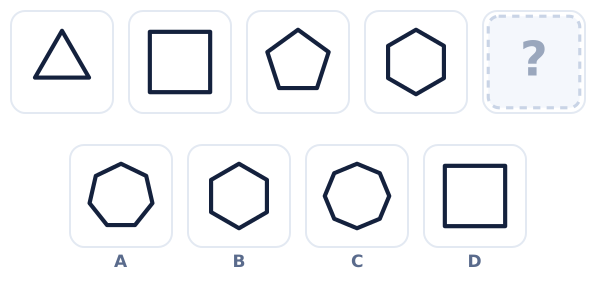
The method — STEP:
- Spot the rule. What changed from box 1 to box 2? The triangle became a square: one more side.
- Test it holds. Square to pentagon, pentagon to hexagon: one more side every time. So the empty box needs 7 sides.
- Eliminate. Cross out every option that breaks the rule. B is the hexagon again, C has eight sides, one step too far, and D is a square.
- Pick. One is left: A, the seven-sided shape.
The trap: B, the hexagon, is the box before the gap. It looks right because it is already in the row, but the rule has to step on once more. In the exam, the empty box can be anywhere in the row, and two or three things often change at once, so check every rule on every option.
Shape analogies
What it looks like:
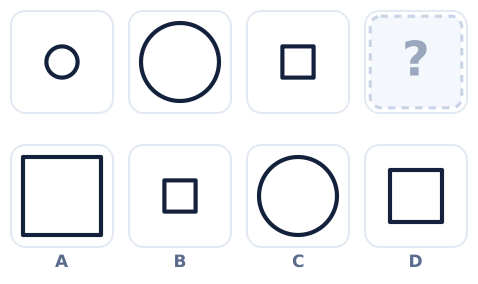
The method:
- Work out what happened to the first shape to make the second: did it grow or shrink? Flip? Change shading? Gain or lose a part? Here the small circle simply grew.
- Say it like a sentence: "small circle becomes big circle… so small square becomes big square." Answer: A.
- Do exactly the same set of changes to the third shape — all of them, not just the most obvious one. If the first shape had grown and turned black, your answer must do both.
The trap: spotting one change and stopping. When two things change at once, the wrong options are usually the ones that got only the obvious change right. List every change before you look at the options.
Matrices (the missing square)
What it looks like:
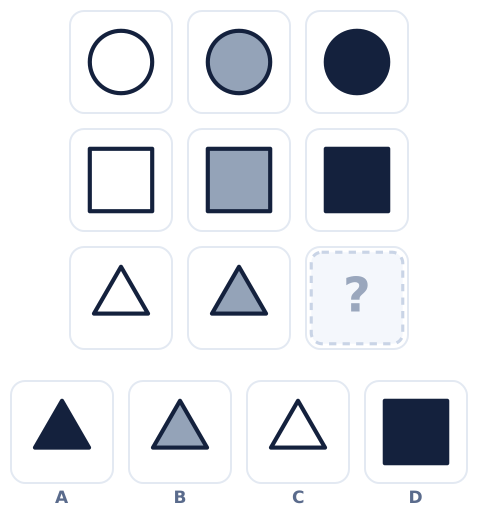
The method:
- Read the grid like a book: what changes along the row? Here the shading goes white → grey → black.
- What changes down the column? The shape goes circle → square → triangle.
- The missing square has to obey both rules at once: third row means triangle, third column means black. Answer: A, the black triangle.
- Test each feature on its own: does the row change the shape? The shading? The size? Fix one at a time.
The trap: option D — the black square — obeys the row rule (it is black, which is what the third column needs) but not the column rule (the bottom row is triangles). Half-right is the examiner's favourite wrong answer.
Odd one out (shapes)
What it looks like:
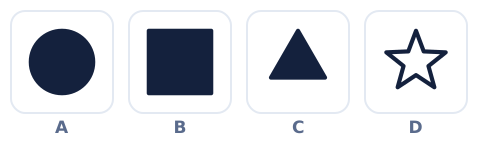
The method:
- Find the rule that most of the shapes share — count sides, check shading, look at direction. Here three of the four are filled in.
- The star is the only empty one. Answer: D.
- Test your rule on every shape. It should catch exactly one rule-breaker. If it knocks out two, your rule is wrong — find a sharper one.
The trap: the star also looks different because it's spiky — so is the rule spiky or empty? Check the others: the circle, square and triangle are all different shapes too, so shape can't be the rule. But they're all filled — and the star isn't. Shading is the rule that's left standing.
Similarities (join the club)
What it looks like: two or three example figures that belong to a secret club, and five options. Pick the figure that could join the club.
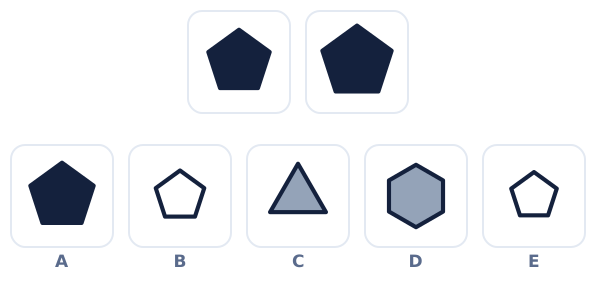
The method — FIND:
- Find what's the same. Both examples are pentagons: five sides.
- Inspect it further. Look again. Both are also black, so that is a second rule. They are different sizes, so size is not a rule.
- Narrow the options. C is a triangle and D is a hexagon, so their sides are wrong. B and E are pentagons, but white.
- Decide. One is left standing: A, the black pentagon.
The trap: stopping at the first rule you find. B and E are exactly what you would pick if you stopped at "five sides". The answer has to keep every rule. And whatever differs between the examples, like the size here, is what you can ignore.
Shape codes
What it looks like:
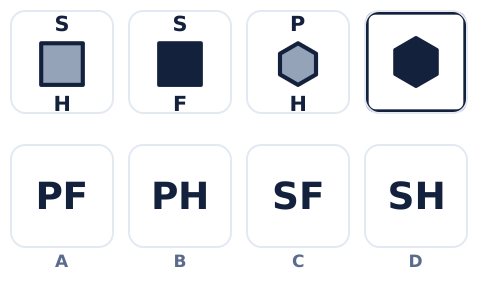
The method:
- Each code letter stands for one feature. Find two shapes that share a letter — whatever they have in common is what that letter means. Both squares have S on top → S means square. Both grey shapes have H underneath → H means grey.
- That unlocks the rest: P must be hexagon, F must be black.
- Read off the code for the boxed shape — a black hexagon → P on top, F underneath. Answer: A, PF.
The trap: option D, SH, describes the first shape you looked at, not the boxed one. Once the code is cracked, slow down and apply it to the right figure.
Exam technique: the last 10%
Time per question is short — about 35 to 40 seconds on a typical paper. That's the design, not a disaster. Nobody is expected to finish comfortably.
- If a question won't crack in about 40 seconds, skip it and move on. One stubborn question can quietly eat the time for five easy ones later. Mark it, come back at the end.
- Answer everything before time is called. No marks are deducted for wrong answers, so cross out what you can and guess from what's left.
- Do the checkable step. Most methods in this guide end with a check that takes five seconds — read the sentence back, test the second pair, re-count the jump. That check is where careless marks come back.
- Practise little and often. Ten focused minutes a day beats a two-hour marathon at the weekend — these are skills, and skills grow with reps, not cramming.
Go deeper: a full guide for every question type
Every type on this page has an in-depth guide. There are 24 of them, one for nearly every type on this page — with two shortcuts: the quick alphabet-code trick above (A=1, B=2…) stays here in this master guide rather than getting its own page, and the Closest Meaning, Opposite Meaning and Related Words guides work through the two-group form in depth (pick one word from each group), with the same method carrying over to the one-word Closest Meaning and Related Words questions shown above. The word, letter, code, maths and reading-information guides each give you a fully worked example, the traps, and practice questions to try yourself. The Non-Verbal guides give you worked examples, the traps, and a full list of the rules you'll meet.
Word meaning: Closest Meaning · Opposite Meaning · Odd One Out · Related Words · Double Meanings · Compound Words
Letters and word-building: Hidden Word · Move a Letter · Complete the Word · Letter Connections · Word Pairs · Make a Word
Codes: Letter Codes · Number Codes
Maths in disguise: Number Series · Letter Series · Letter Analogies · Letters for Numbers · Complete the Sum
Reading Information: Reading Information — work out the answer, or decide what must be true
Non-Verbal Reasoning: Series · Analogies · Matrices · Odd One Out · Similarities · Shape Codes
Spatial Reasoning: 2D Views · Different Views · Cube Views · 3D Rotation · Building Blocks · Cubes and Nets · Shaded Nets · Folding · Fold and Punch · Hidden Shapes · Connecting Shapes · Complete the Shape
Practise every type in this guide
Almost every question type on this page is practised inside Brainblox: 11+ Verbal and Non-Verbal Reasoning across 25+ learning games and full timed mock exams (80 questions in 50 minutes), plus a daily 10-minute challenge and practice that re-serves the exact questions you got wrong. Each type is served by the games that suit it, so no single type appears in all 15. The two-bracket questions — where you pick one word from each of two groups — live in the mock exams and in practice rather than in the games, because a two-column answer doesn't fit inside a game. When you miss a question, a tip appears teaching the method — the same methods in this guide.
All example questions on this page come from the Brainblox question bank. Brainblox is an independent app: not affiliated with, endorsed by or licensed by any exam board, school or assessment publisher, and it contains no past papers. Question content follows the formats used in UK 11+ entrance exams.